
On 11/ 12/ 2021 MSA-CESS awarded Security University re- accreditation until 2032. The Middle States Standards for Accreditation can be viewed Learn more at: www.msa-cess.org
Qualified Matters. Success is doing it once. Mastery is the ability to do it repeatedly at the same level of excellence. Many people will experience success, but few will experience mastery.
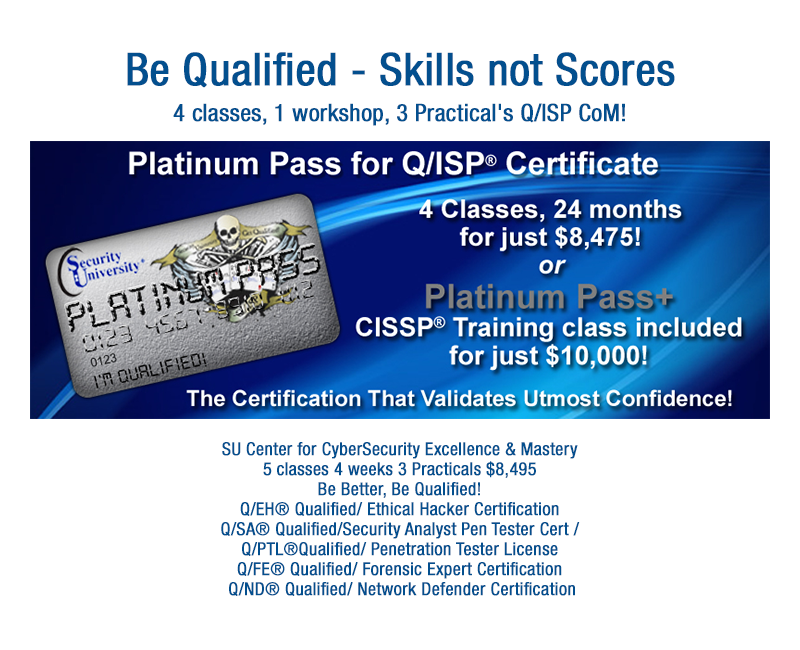
Earn your Qualified Q/SP, Q/ISP, Q/IAP, Q/SSE, Q/CND - Qualified/ Cybersecurity Certificate Program of Mastery. SU courses are SCHEV Certified to Operate, MSA-CESS accredited, and Army, USAF & Spouse Credential Assistance Program approved.
Expect to advance your cyber career skills at SU. SU's 5 Qualified/ Cybersecurity Professional Certificate Programs of Mastery (CPoM) Q/ISP, Q/IAP, Q/SSE, Q/WP, Q/CND are designed to provide you with 5 levels of cyber competency. Each CPoM includes mastery level hands-on cyber skills learning, while earning industry recognized ybersecurity credentials that advance your career and increase your salary. At SU you learn in live "how to" do the cyber task in step-by-step hands-on workshops. SU Testing's Qualified exams are competency/ performance based mastery level exams with "practical’s to validate you for employers. Practicals qualify your cyber skills capabities. Qualified Matters. Every SU class is structured to provide cyber skills and credentials that matter from Mastery level instructors.
SU is internationally recognized, respected by the IS community, and well-received by employers and for good reason, high student success on cyber exams on their first try or come back for FREE. Contact us anytime 203-249-8364.
Download SU Catalog »Download Addendum »View Class Schedule »Read Testimonials »Download Brochure »
| Date | Class Name | Location | Cost |
|---|---|---|---|
|
January 1 - December 31, 2023 |
Q/ISP Qualifed/ Information Security Professional Cert Program of Mastery CPoM $26,500 |
Q/ISP Certificate Program of Mastery |
$26,500 |
|
January 1 - December 31, 2023 |
Q/SSE Qualified/ Software Security Expert Professional Certificate Program of Mastery CPoM $26,500 |
Q/SSE Certificate Program of Mastery |
$26,500 |
|
January 1 - December 31, 2023 |
Q/WP Qualified/Wireless Professional Certificate Program of Mastery CPoM | $26,500 |
|
|
January 1 - December 31 |
Q/IAP Qualified/ Information Assurance Professional Cert Program of Mastery PoM |
Q/IAP Certificate Program of Mastery |
$26,500 |
|
January 1 - December 31 |
Q/CND Qualified/ Cyber Network Defense Certificate Program CPoM $26,500 |
Q/CND Certificate Program of Mastery |
$26,500 |
|
February 1 - December 15 |
Qualified/ Software Security Classes 9 weeks $26,500 |
Q/SSE Certificate Program of Mastery |
$26,500 |
|
April 22-26 |
SecurityPlus w/ exam $3,495 |
Hybrid pre-class study + face to face instruction Reston VA - Exam 4/24 Q/ISP Cert Program of Mastery |
$3,495 |
|
April 22-26 |
CISSP Class 2 for 1 /(The Official SU) CISSP Training Class $4,790 |
Hybrid + face to face instruction Reston VA Q/ISP, Q/IAP, Q/CND, Q/WP Certificate Program of Mastery |
$4,790 |
|
April 22-26 |
CISM CLASS (The Official SU) Training Class w/ eStudy + Exam $4,990 |
Hybrid + face to face instruction Reston VA - Q/ISP Certificate Program of Mastery |
$4,990 |
|
April 22-26 |
CISSP CLASS (The Official SU) Training Class w exam $4,790 |
Hybrid + online & face to face instruction Reston VA - Q/ISP, Q/IAP, Q/CND, Q/WP Certificate Program of Mastery |
$4,790 |
|
April 29 - May 3 |
Q/WSP Qualified /Wireless Security Professional $3,990 |
Hybrid + face to face instruction Reston VA Q/WP Cert Program of Mastery |
$3,990 |
|
May 1-14 |
Python/Powershell Incident Response class w Exam |
Hybrid + face to face instruction Reston VA - Q/ISP Certificate Program of Mastery |
$3,990 |
|
May 1-30 |
Q/ST Qualified/Software Testing $3,990 |
Hybrid + face to face instruction Reston VA Exam May 30 Q/SSE Certificate Program of Mastery |
$3,990 |
|
May 1-30 |
Introduction to Reverse Engineering |
Hybrid + face to face instruction Reston VA Q/SSE Cert Program of Mastery |
$3,990 |
|
May 6-10 |
Cloud Computing Security Knowledge Certification (CCSK and Plus) Class w/exam |
Hybrid + face to face instruction Reston VA - Exam 5/10 Q/ISP Certificate Program of Mastery |
$3,990 |
|
May 13-17 |
PMP class with exam $3,990 |
Hybrid + face to face instruction Q/IAP Certificate Program of Mastery |
$3,990 |
|
May 13-31 |
QWP and QWSP Bootcamp - Qualified Wireless Professional/ Wireless Security Professional $4,690 |
Instructor Led Reston VA - Practice Exams Q/WP Certificate Program of Mastery |
$4,690 |
|
May 18-22 |
CEH Certified Ethical Hacker and Q/EH Qualified Ethical Hacker Class |
Hybrid online and Face to face in FT Liberty Exam May 22 Q/ISP Cert Program of Mastery |
$3,990 |
|
May 20-24 |
SecurityPlus w/ exam $3,495 - SOLD OUT |
Hybrid + face to face instruction Reston VA Exam May 24 Q/ISP Cert Program of Mastery |
$3,495 |
|
May 22-29 |
Memorial Day Holiday | ||
|
May 27-31 |
Linux Proficiency Certification class $3,990 |
Hybrid + face to face instruction nites & weekends Reston VA Instructor Led Dr Behzad Salimi Q/ISP, Q/CND, Certificate Program of Mastery |
$3,990 |
|
June 1-16 |
Scrum Master Certification Class $3,990 |
Hybrid + face to face instruction Reston VA Q/IAP Cert Program of Mastery |
$3,990 |
|
June 1-16 |
Q/WP Qualified / Wireless Professional for Q/WP exam $3,99 |
Hybrid + face to face instruction Reston VA Q/WP Cert Program of Mastery |
$3,990 |
|
June 1-18 |
Q/CA RMF Qualified CandA Certification and Accreditation RISK MGT $3,990 |
Hybrid + face to face instruction Reston VA - Exam Jun 18 Q/IAP Certificate Program of Mastery |
$3,990 |
|
June 1-29 |
Q/CDA Qualified/ Cyber Defense Analyst Certification Class and Exam |
Hybrid + face to face instruction Reston VA Q/CND Cert Program of Mastery |
$3,990 |
|
June 1-30 |
Q/NSP Qualified Network Security Policy Admin $3,990 |
Hybrid + face to face instruction Reston VA Exam 6/30 Q/IAP Certificate Program of Mastery |
$3,990 |
|
June 1-30 |
Q/WLANPD Qualified/ Wireless Local Area Network Planning and Design class and exam |
Hybrid + face to face instruction Reston VA Q/WP Cert Program of Mastery |
$3,990 |
|
June 1-30 |
ISO 27001 ISMS Lead Implementer + Exam $4,990 |
Hybrid + face to face instruction Reston VA exam Jun 30 Q/IAP Certificate Program of Mastery |
$4,990 |
|
June 1-30 |
IDS III: On-site Log Analysis, Event Correlation and Response (Custom) Certification Class and Exam |
Hybrid + face to face instruction Reston VA Q/CND Cert Program of Mastery |
$3,990 |
|
June 1 - July 31 |
Q/FE Qualified/ Forensic Expert Class $3,990 |
Hybrid + face to face instruction6/17-21 Reston VA Exam June 21 Q/ISP Certificate Program of Mastery |
$3,990 |
|
June 1 - August 31 |
Q/SSE Qualified Software Security Expert Q/SSPT |
Hybrid + face to face instruction Reston VA Q/SSE Cert Program of Mastery |
$3,990 |
|
June 3-7 |
Q/CND IDS I |
Hybrid + face to face instruction Reston VA Q/CND Cert Program of Mastery |
$3,990 |
|
June 3-28 |
Q/WP Qualified / Wireless Professional for Q/WP exam $3,990 |
Hybrid + face to face instruction Reston VA - Exam June 28 Q/WP Cert Program (of Mastery) |
$3,990 |
|
June 10-14 |
CASP class $3,495 and exam $495 |
Hybrid pre-class study + face to face Reston Va instruction exam 6/14 - Q/ISP Certificate Program of Mastery |
$3,990 |
|
June 10-21 |
Q/WSP Qualified /Wireless Security Professional $3,990 |
Hybrid + face to face instruction Reston VA Q/WP Cert Program of Mastery |
$3,990 |
|
June 10-30 |
Q/SA Qualified Security Analyst class and exam $3,990 + Penetration Tester/ QPTL $510 |
Hybrid + face to face instruction Reston VA till exam June 14 pen test Q/ISP Certificate Program of Mastery |
$4,500 |
|
June 15 - August 31 |
Qualified/ Security Awareness Training Class exam $3,990 |
Hybrid + face to face instruction Reston VA Exam Aug 31 Q/ISP Cert Program of Mastery |
$3,990 |
|
June 17-21 |
CEH Certified Ethical Hacker and Q/EH Qualified Ethical Hacker Class |
Hybrid + face to face instruction Reston VA Exam June 21 Q/ISP Cert Program of Mastery |
$3,990 |
|
June 17-21 |
Certified ISO 27001 Lead Auditor Course $3,990 |
Hybrid + face to face instruction Exam 7/28 QISP Certificate Program of Mastery |
$3,990 |
|
June 17-21 |
CCP CMMC level 1-3 class $3,990 |
Hybrid + face to face instruction Reston VA CCA Level II evaluator class |
$3,990 |
|
June 17-21 |
SecurityPlus w/ exam $3,495 |
Hybrid + face to face instruction Reston VA Exam Jun 21 Q/ISP Cert Program of Mastery |
$3,495 |
|
June 25-28 |
CCA CMMC level 1-3 class $3,990 |
Hybrid + face to face instruction Reston VA |
$3,990 |
|
June 25-29 |
Advanced Cloud Security and Applied SecDevOps (CCSK Advanced) Class and Exam |
Hybrid + face to face instruction Reston VA Q/ISP Cert Program of Mastery |
$3,990 |
|
June 30 - July 8 |
Independence Day Holiday | ||
|
July 1-30 |
Catching Hackers II-Network Defense Systems Course $3,990 |
Hybrid + face to face instruction Exam 7/30 Reston VA Q/ISP Certificate Program of Mastery |
$3,990 |
|
July 1-30 |
Fundamentals of Secure Software Programming Class and Exam |
Hybrid + face to face instruction Reston VA Q/SSE Cert Program of Msastery |
$3,990 |
|
July 1-30 |
Q/WNDO Qualified Wireless Deceptive Network Optimization Class and exam $3,990 |
Hybrid + face to face instruction Reston VA Q/WP Cert Program of Mastery |
$3,990 |
|
July 1-31 |
Linux Proficiency Certification class and exam $3,990 |
Hybrid + face to face instruction nites & weekends Reston VA Exam 7/31 Q/ISP Certificate Program of Mastery |
$3,990 |
|
July 8-12 |
SecurityPlus $2,995 + exam $495 (2 enrollments) |
Hybrid + face to face instruction FT Liberty ARMY AI Exam July 12 Q/ISP, Cert Program of Mastery |
$3,495 |
|
July 8-19 |
Q/AAP Qualified Access, Authentication and PKI Professional $3,990 |
Hybrid + face to face instruction Reston VA incl exam Jul 19 Q/IAP Certificate Program of Mastery |
$3,990 |
|
July 8 - August 8 |
Q/ND Qualified Network Defender $3,990 |
Reston VA Hybrid pre-class study + face to face instruction exam Oct 30 - Q/ISP Certificate Program of Mastery |
$3,990 |
|
July 15-19 |
Q/AAP Qualified Access, Authentication and PKI Professional $3,990 |
Hybrid + face to face instruction Reston VA incl exam July 19 29 Q/IAP Certificate Program of Mastery |
3,990 |
|
July 15 - August 30 |
Qualified/ CDA Cyber Defense Analyst Certification Class $3,990 |
Hybrid + face to face instruction Reston VA Exam Jul 19 Q/CND Cyber Network Defense Cert Program of Mastery |
$3,990 |
|
July 22-26 |
CASP class $3,495 and exam $495 |
Hybrid pre-class study + face to face Reston Va instruction exam Jul 26 Q/ISP Certificate Program of Masteryert Program of Mastery |
$3,990 |
|
July 22-26 |
CISSP CLASS (The Official SU) Training Class w/ eStudy $3,990 |
Hybrid + face to face instruction Reston VA Q/ISP, Q/IAP, Q/CND, Q/WP Certificate Program of Mastery |
$3,990 |
|
July 22-26 |
CISSP Class 2 for 1 /(The Official SU) Training Class w/ eStudy $4,790 |
Hybrid & Instructor led Reston Q/ISP, Q/IAP, Certificate Program of Mastery |
$4,790 |
|
August 1-29 |
Q/SSE Qualified Software Security Expert Q/SSTP |
Hybrid + face to face instruction Reston VA Q/SSE Cert Program of Mastery |
$3,990 |
|
August 1-29 |
Q/ISO Qualified/ Chief Information Security Officer |
Hybrid + face to face instruction Reston VA Q/IAP Certi Program of Mastery |
$3,990 |
|
August 1-30 |
Q/WP Qualified / Wireless Professional for Q/WP exam $3,990 |
Hybrid + face to face instruction Reston VA Aug 30 Q/WP Cert Program of Mastery |
$3,990 |
|
August 1-30 |
Q/SSP Qualified/ Software Security Penetration Testing Class and Exam |
Hybrid online and Face to face |
$3,990 |
|
August 1-30 |
Q/ST Qualified/ Software Security Testing Class and Exam |
Hybrid online and Face to face |
$3,990 |
|
August 1-31 |
IDS II: Systems to Defend Networks and Exam |
Hybrid + face to face instruction Reston VA Exam 8/31 Q/CND Cert Program of Mastery |
$3,990 |
|
August 1-31 |
Q/ND Qualified Network Defender $3,990 |
Hybrid + face to face instruction Reston VA Exam Aug 31 Q/ISP Certificate Program of Mastery |
$3,990 |
|
August 4-15 |
QWP and QWSP Bootcamp - Qualified Wireless Professional/ Wireless Security Professional $4,690 |
Instructor Led Reston VA 2 Exams Q/WP Certificate Program (of Mastery) |
$4,690 |
|
August 5-16 |
CCP CMMC level 1-3 class $3,990 |
Hybrid online and face to face Reston VA Q/IAP Cert Program of Mastery |
$3,990 |
|
August 5-30 |
Q/WAD Qualified Wireless Analyst and Defender Bootcamp $3,990 |
Hybrid + face to face instruction Reston VA Exam Aug 30 Q/WP Certificate Program of Mastery |
$3,990 |
|
August 19-23 |
CEH Certified Ethical Hacker and Q/EH Qualified Ethical Hacker Class |
Kevin Cardwell instructor exam Aug 23 |
$3,990 |
|
August 19-23 |
CASP class $3,495 and exam $495 |
Hybrid + face to face instruction FT Liberty Exam Aug 23 Q/ISP Certificate Program of Mastery |
$3,990 |
|
August 19-23 |
CASP class $3,495 and exam $495 |
Hybrid online and Face to face Reston VA exam Aug 23 |
$3,990 |
|
August 26-30 |
Q/SA Qualified Security Analyst class and exam $3,990 + Penetration Tester/ QPTL $510 |
Hybrid + face to face instruction Ft Liberty VA Exam 8/30 Q/ISP Certificate Program of Mastery |
$4,500 |
|
August 26-30 |
SecurityPlus w/ exam $3,495 |
Hybrid pre-class study + face to face instruction Reston VA - Exam Aug 30 Q/ISP Cert Program of MasteryCert Program of Mastery |
$3,495 |
|
September 1 - August 31 |
CISM CLASS (The Official SU) Training Class w/ eStudy + Exam $4,990 |
Hybrid + face to face instruction Reston VA - Q/ISP Certificate Program of Mastery |
$4,990 |
|
September 1-30 |
How to Break and FIX Web Software Security |
Hybrid + face to face instruction Reston VA Q/SSE Cert Program of Mastery |
$3,990 |
|
September 1-30 |
How to Break and FIX Software Class and Exam |
Hybrid + face to face instruction Reston VA Q/SSE Cert Program of Mastery |
$3,990 |
|
September 1-30 |
Hacking Software - Attacker Techniques Exposed Class and Exam |
Hybrid + face to face instruction Reston VA Q/SSE Cert Program of Mastery |
$3,990 |
|
September 1 - October 15 |
PMP class with exam $3,990 |
Hybrid + face to face instruction Reston VA Q/IAP Certificate Program of Mastery |
$3,990 |
|
September 2-5 |
Labor Day Holiday | ||
|
September 9-13 |
Q/SA Qualified Security Analyst class and exam $3,990 + Penetration Tester/ QPTL $510 |
Hybrid + face to face instruction Reston VA Exam 9/13 pen test Q/ISP Certificate Program of Mastery |
$4,500 |
|
October 21-25 |
Q/SA Qualified Security Analyst class and exam $3,990 + Penetration Tester/ QPTL $510 |
Hybrid + face to face instruction Exam 10/25 Reston VA practical Q/ISP Cert Program of Mastery |
$4,500 |
|
November 20-24 |
Thanksgiving Holiday | ||
|
December 2-6 |
Q/SA Qualified Security Analyst class and exam $3,990 + Penetration Tester/ QPTL $510 |
Hybrid + face to face instruction Reston VA Exam Dec 6 Pen test Q/ISP Cert Program of Mastery |
$4,500 |
|
December 13 - January 25 |
Winter Break, Christmas and New Year's Holiday | ||
|
December 31-31 |
Q/ISP Annual Renewal Fee - Q/ISP Certificate Program of Mastery | $200 |
|
|
December 31-31 |
Q/ISP Annual Renewal Fee - Q/ISP Certificate Program (of Mastery) | $150 |
|
|
December 31-31 |
Q/ISP Annual Renewal Fee - Q/ISP Certificate Program (of Mastery) | $50 |
|
|
February 17-21 2025 |
Presidents Week Holiday | ||
 Q/ISP®
Qualified/ Information Security Professional Certificate Program of Mastery (CPoM)
Q/ISP®
Qualified/ Information Security Professional Certificate Program of Mastery (CPoM)These classes are NSA-CNSS 4011 / 4012 / 4013 / 4015 / 4016A approved
SUT Q/ISP Certification exams are available without training classes
Many classes are ARMY, USAF &Spouse Credential Assistance Program Approved.
 Q/IAP® Qualified/ Information Assurance Professional Certificate Program of Mastery (CPoM)
CNSS 4011/4012/4015/4016A approved
All SUT Q/IAP CPoM certification exams are available without training classes
“Many classes are ARMY, USAF & Spouse Credential Assistance Program Approved.”
 Q/SSE®
Qualified/ Software Security Expert Certificate Program of Mastery (CPoM)
Q/SSE®
Qualified/ Software Security Expert Certificate Program of Mastery (CPoM)All SUT Q/SSE CPoM certification exams are available without training classes
“Many classes are ARMY, USAF & Spouse Credential Assistance Program Approved.”
 Q/WP®
Qualified/ Wireless Professional Certificate Program of Mastery (CPoM)
Q/WP®
Qualified/ Wireless Professional Certificate Program of Mastery (CPoM)All SUT Q/WP CPoM certification exams are available without taking SU training classes
“Many classes are ARMY, USAF & Spouse Credential Assistance Program Approved.” ”
 Q/CND®
Qualified/ Cyber Network Defense Professional Certificate Program of Mastery (CPoM)
Q/CND®
Qualified/ Cyber Network Defense Professional Certificate Program of Mastery (CPoM)All SUT Q/CND CPoM certification exams are available without training classes
“Many classes are ARMY, USAF & Spouse Credential Assistance Program Approved.”
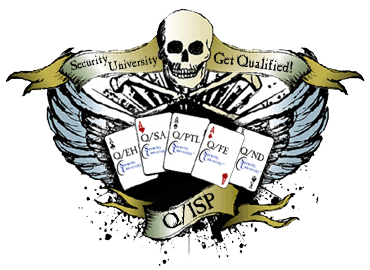 Security University's Q/ISP logo represents the highest commitment for Cyber Security professionals in the world. It is a custom logo created to honor security professionals who aspire to master the most valued tactical hands-on security skills training, certifications and licenses in the world. It shows you have mastered "tactical hands-on cybersecurity skills" and earned a "cybersecurity certification".
The skull represents brains. The ribbons symbolize integrity and honor. The wings exemplify the ability to soar towards your true potential (and above the turkeys you work with). The playing cards attest that you've mastered the security skills to win at mitigating security.
Contact SU 203-249-8364
Since 1999 SU Training Courses, Certificates Programs of Mastery and Micro Credential Programs qualify and validate highly qualified, hands-on performance based cyber security training for information security/ cyber professionals. SU is accredited by MSA-CESS and ARMY Credential Assistance Program Approved.
The Q/ISP Certificate Program of Mastery rigorously Qualifies & Validates CyberSecurity Professionals with hands-on tactical security skills necessary to deliver the capability to establish, operate, defend, exploit, and attack in, through, and from the cyberdomain.
Qualified Cyber Education Matters.
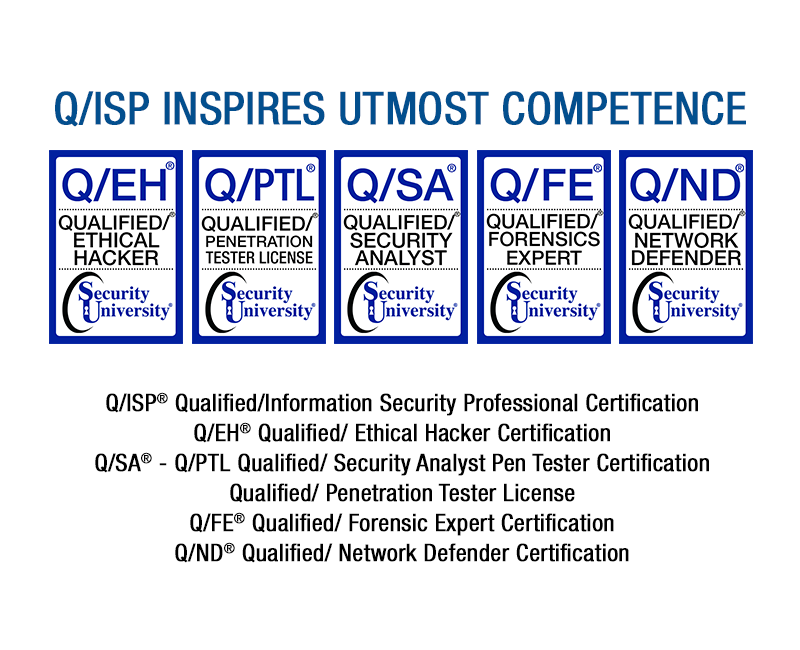
Q/EH® - Qualified/ Ethical Hacker Certification
Learn More »
Q/SA® - Qualified/ Security Analyst Certification
Learn More »
Q/PTL® - Qualified/ Penetration Tester License
Learn More »
Q/FE® - Qualified/ Forensic Expert Certification
Learn More »
Q/ND® - Qualified/ Network Defender Certification
Learn More »
Q/CSP® - Qualified/ Cyber Security Professional Certification

Government entities in the Middle East have been targeted as part of a previously undocumented campaign to deliver a new backdoor dubbed CR4T. Russian cybersecurity company Kaspersky said it discovered the activity in February 2024, with evidence suggesting that it may have been...
A new info-stealing malware linked to Redline poses as a game cheat called 'Cheat Lab,' promising downloaders a free copy if they convince their friends to install it too. Redline is a powerful information-stealing malware capable of harvesting sensitive information from infecte...
The National Security Agency (NSA) issued a cybersecurity information sheet (CIS) on Monday to share best practices for deploying secure and resilient AI systems. The guidance marks the first release from the NSA’s Artificial Intelligence Security Center (AISC), which the agen...
A rise in infostealer malware attacks over the past three years has enabled cybercriminal groups to turn credential stealing into a major money-making business, paving the way for new entrants in the field and sophisticated hacking techniques to breach corporate defenses. Cybers...
The Cybersecurity and Infrastructure Security Agency (CISA), Federal Bureau of Investigation (FBI), and the Office of the Director of National Intelligence (ODNI) released Securing Election Infrastructure Against the Tactics of Foreign Malign Influence Operations, a guidance docu...
Trust in cybersecurity tools has become one of the biggest challenges facing critical national infrastructure (CNI) providers as sophisticated nation-state attacks proliferate, according to a new report from Bridewell. The IT services firm’s latest Cyber Security in Critical N...
Certified to Operate by State Council of Higher Education for Virginia (SCHEV)
Accredited by MSA-CESS
‘‘GI Bill® is a registered trademark of the U.S. Department of Veterans Affairs (VA).
More information about education benefits offered by VA @ http://www.benefits.va.gov/gibill."


